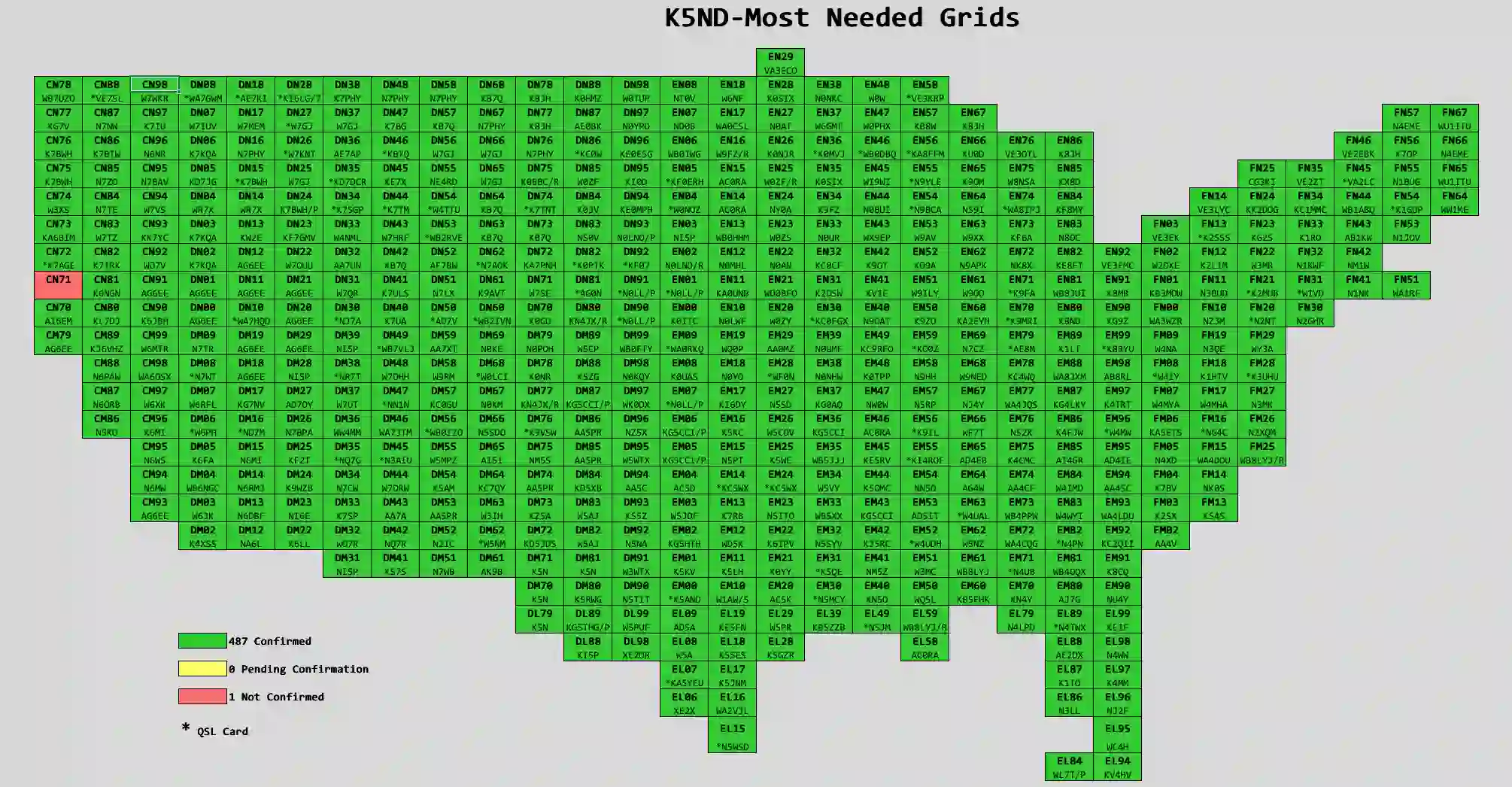

Late last night, I managed to work grid 487 on my journey to 488 for the Fred Fish Memorial Award (FFMA). Big thanks to Barry, K7BWH, for deciding to drive out to the Pacific Coast and activate this extremely rare grid that some 45% of FFMA chasers still need.
Butt-in-Chair
This was, of course, a major butt-in-chair moment. For those unfamiliar with the term, it comes from a long line of contesters who demonstrate time and again that to achieve a big contest score, you need to be in the chair at all times, working hard to accumulate QSOs. For grid chasers, it may not be an endurance effort, but you do need to be there to make that rare grid QSO when it decides to make an appearance at your radio.
For this particular mile marker, Barry hinted about a possible trip to CN75 a few days ago and announced it the day of his activation. I perused my calendar, cleared a few events, and got ready to monitor the propagation.
Eyes-Online
The eyes-online for this one started with APRS and tracking Barry’s progress through Oregon to reach the coast and grid CN75. It continued with reports from Barry on his efforts once there on Slack VHF-Chat. Then it was watching DXmaps and PSKreporter to see when he was transmitting and how propagation was handling his signal.
Play-by-Play
On the first day, nothing much happened, though a few nearby stations reported his signal. On the second day, not much happened for most of the day. I even broke out of the butt-in-chair routine to grab a DFW Contest Group lunch.
That evening, things took off. DXmaps showed a huge opening across the USA into the Pacific Northwest. There were even instances of 2-meter Sporadic E contacts. Digging deeper into PSKreporter showed Barry’s signal reaching quite a few people, including in Florida! But nothing here.
The eyes-online also revealed a move to FT4 and 50.318. Barry announced it, and then you could see the various stations that heard him on that frequency via PSKreporter.
Here locally, I wasn’t hearing him. I saw various people calling him, using all sorts of permutations of his call sign in their WSJT-X software. I saw KB7BWH, K7BHW, K7WHB, and perhaps others. Of course, they hadn’t heard him either. They were just blind calling, hoping he would come back to them. Most of them were even on the right sequence.
Throughout my efforts, the online tools and chat page helped me catch an early glimpse of a frequency and mode change and later confirmed that Barry was still transmitting there.
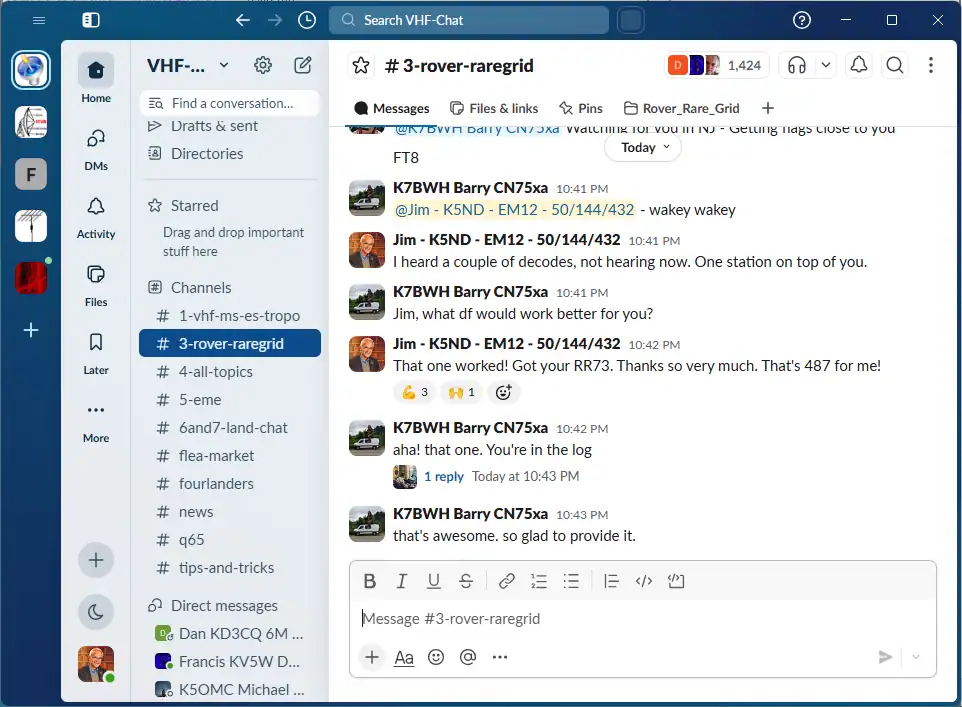
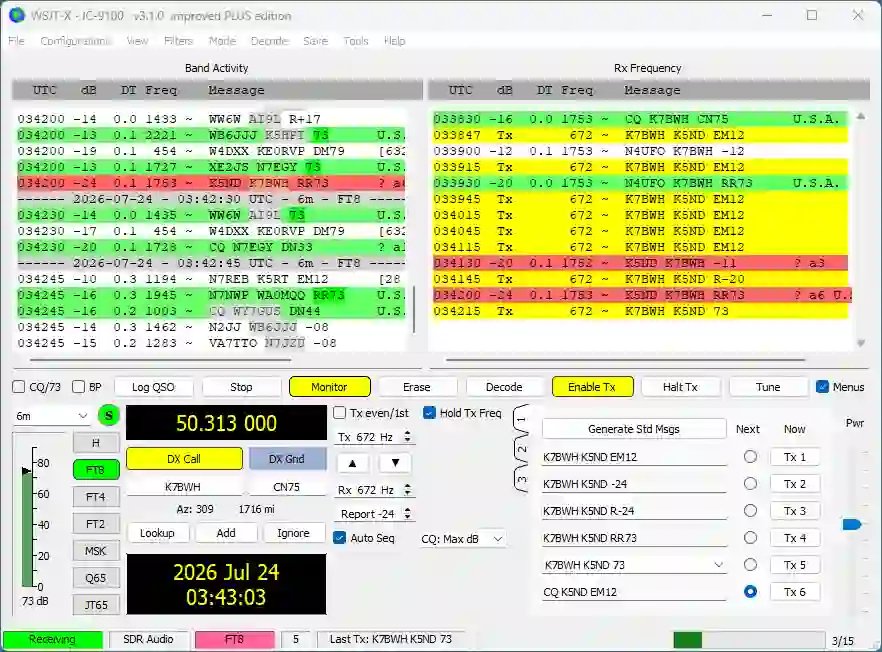
After he no doubt worked all those heard on FT4, I picked up a message on VHF-Chat that he’d moved to 50.313 and FT8. I switched and, for the first time, decoded him working a station. I immediately started calling. Then he sent me a message on VHF-Chat — “wakey wakey.” I responded while continuing to transmit. Then his signal report arrived, followed by the RR73 at an SNR of -24!
I decoded him once or twice the rest of the evening while admiring my new rare grid. His confirmation quickly appeared in Logbook of the World.
Honest to gosh, his signal was heard at my station for roughly two minutes. That’s all it took, and that’s all I needed. But I also needed to be in my chair and maintain full situational awareness of frequency, mode, etc. And, as a reminder, that situational awareness began with Barry’s first hint of activating the grid.
There you have it, FFMA Mile Marker 487. Thanks, Barry, K7BWH. You can read more about his rove at CN75 Lincoln City, Oregon. Check out the map of the grid and photos.
BTW. Here’s my current FFMA Needed Grids Map.