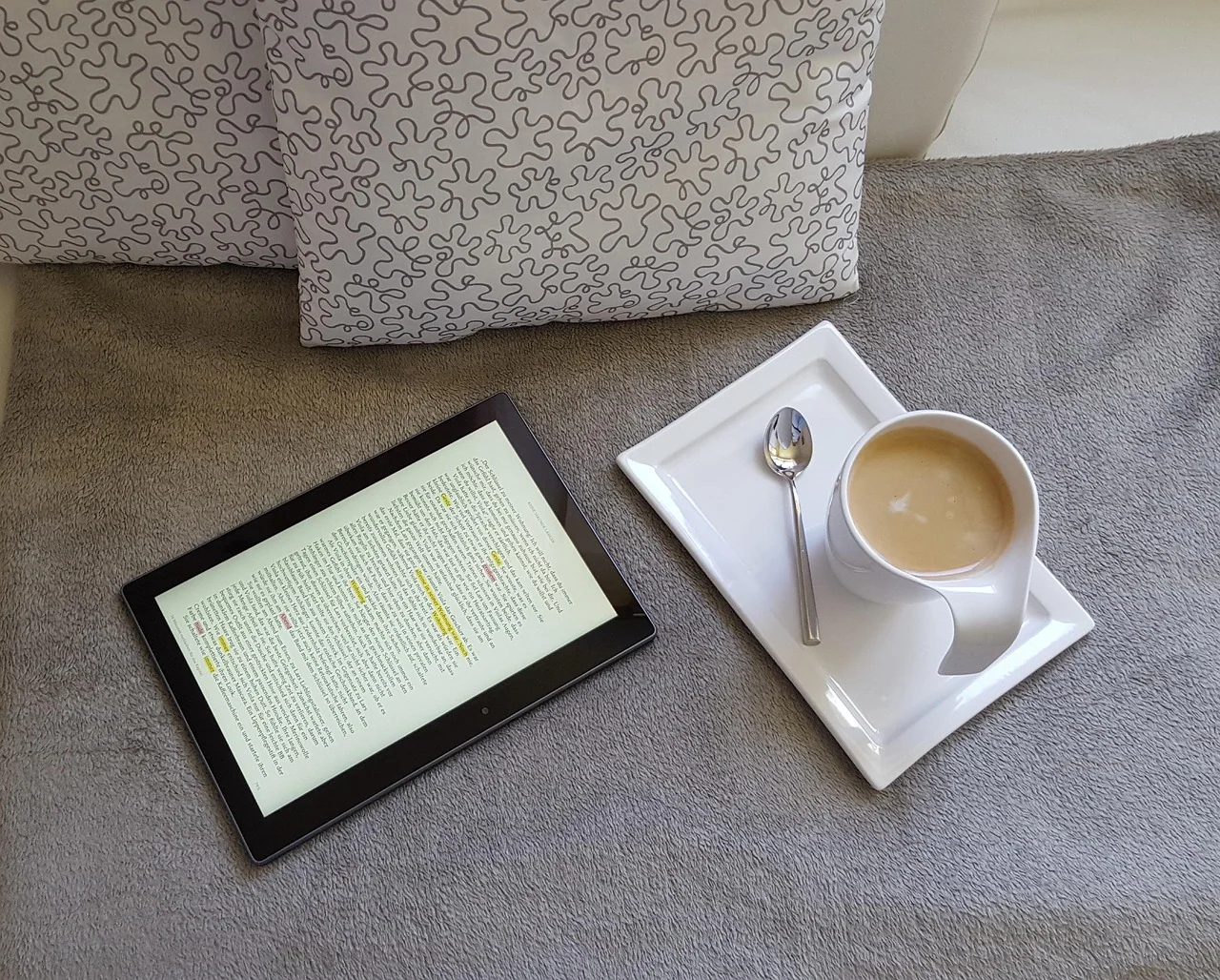

The Wall Street Journal’s Free Expression newsletter recently published an article titled “Scrolling Ourselves to Death.” Its opening lines paint a dire picture: “Reading is on life support. Fewer than half of American adults read a single book in 2022. Only 16% read books for pleasure.”
I can admit that I’ve fallen into the scrolling challenge. When I take a break, I sometimes scroll aimlessly through posts on Facebook and X. I also find it somewhat challenging to read the Southern Anglican’s daily Substack post, which typically tops 3,000 words.
Scrolling vs. Book Reading — K5ND Edition
Even so, I’m at the opposite extreme when it comes to my passion for reading. Kindle reports that I’ve read 120 books so far in 2026, plus 150 last year. That’s consistent with my 125-week reading streak.
My family fostered my love of reading. I grew up surrounded by shelves full of books and stacks piled around chairs and couches. One of my earliest Christmas gifts was a monthly book-club subscription, and I was in two book clubs before I turned eight. Those books opened the door to travel, technology, and adventure.
Of course, none of this seemed out of the ordinary to me—until my brother pointed out that whenever he visited friends’ homes around the neighborhood, he’d ask where they kept their books because they seemed to be tucked away.
My Favorite Authors
During the pandemic, I wrote a LinkedIn article titled Stay-At-Home — Reading and My Favorite Authors. That was six years ago. Here’s my updated list, which you may find interesting. Not many authors have changed, but I’ve discovered several others whose work I enjoy.
Historical Fiction
This is easily my favorite genre. I love reading history, but few authors can truly bring it to life. Historical fiction fills in the conversations and personalities that often go missing from historical narratives. I also greatly appreciate creative nonfiction that brings the past to life—see my list of authors in that genre below.
- Lew Wallace — can anyone surpass Ben-Hur: A Tale of the Christ or The Prince of India: Why Constantinople Fell as great works of literature?
- Mark Helprin’s writing is absolutely marvelous. A Soldier of the Great War, Refiner’s Fire, and his short stories are fabulous. In Sunlight and In Shadow lingered in my thoughts for days. His newer books include Paris in the Present Tense, Elegy in Blue, and The Ocean and the Stars.
- Neville Shute — Perhaps his best-known book is On the Beach, which was adapted into a 1959 film. I’ve really enjoyed everything I’ve read by him so far, including Pied Piper, Most Secret, A Town Like Alice, Requiem for a Wren, and Trustee from the Toolroom.
- Taylor Caldwell produced a wide range of literature throughout her career. I started with The Great Lion of God, about St. Paul, and then read I, Judas. Dear and Glorious Physician is about St. Luke. Her biblical stories offer rich detail about life in that era and the people in the Bible. I’ve enjoyed many of her other novels, too.
- Patrick O’Brian — I’ve read his twenty Aubrey-Maturin novels about the Napoleonic Wars several times. They’re absolutely fascinating and highly entertaining. I highly recommend them—but don’t blame me if you get hooked.
- Pearl Buck — She won the Nobel Prize, and her book The Good Earth won the Pulitzer Prize. Mao Zedong banned the book, and a few school districts have recently done the same. That’s reason enough to read it. I’ve found her other books to be very good, too.
- Larry McMurtry — Lonesome Dove is a great read, but I also enjoyed all four of his autobiographies and the Duane Moore series.
Science Fiction
I credit Lewis & Clarke with introducing me to this genre, and Arthur C. Clarke and C.S. Lewis remain among my favorite authors. Poul Anderson and his son-in-law, Greg Bear, have also written some superb stories.
- Arthur C. Clarke — Childhood’s End and Rendezvous with Rama are among my favorites. I also like his novel Glide Path, about his experiences in WW II working on radar. I’ve read all his other stories. Highlights include 2001: A Space Odyssey and others in that series.
- Poul Anderson — He has a vast body of work spanning science fiction and fantasy. I enjoy both genres, and I particularly appreciate his libertarian slant. My favorites include the Harvest of Stars series, Tau Zero, There Will Be Time, The Boat of a Million Years, and the King of Ys series.
- Greg Bear — He’s often called a hard science fiction author for the technical detail in his stories. This certainly appeals to me. A few that I’ve read include The Forge of God, Anvil of Stars, Infinity Concerto, and Serpent Mage.
- C.S. Lewis — I greatly value C.S. Lewis’s writing, from the Narnia Chronicles to Christian apologetics. But don’t overlook his Space Trilogy, which is highly entertaining.
- Michael Crichton — I recently discovered a couple of his novels. I’ve really enjoyed the stories and his critical insight into some of today’s climate debates.
Independent Authors
My Kindle+ membership has introduced me to a number of authors who would not fit on any publisher’s list – either because of their storylines or their lower circulation potential. Most of the ones I’ve found are science fiction writers.
Brandon Q. Morris offers entertaining stories about space, paired with serious appendices on the science behind them. Joshua T. Calvert’s first-contact books can each be read on their own, though they’re all connected by encounters with extraterrestrial life. Dr. Michael Nance writes intriguing stories that blend science fiction and paranormal experiences, while Glenn Cooper crafts fascinating tales of present-day intrigue surrounding archaeological discoveries, including the historical archives of the Roman Catholic Church. All are great reads and thoroughly entertaining.
History and Creative Nonfiction
My reading of history relies on first-person accounts and a few superb creative nonfiction writers — all of whom bring those stories to life.
- U.S. Grant — The Personal Memoirs of U.S. Grant is an absolutely crowning achievement from one of our nation’s greatest public servants and heroes. That he completed it on his deathbed to provide an income for his family after his death sums up this great man.
- Winston Churchill — I can’t count the number of books of his that I’ve read over the years. The Second World War and A History of the English-Speaking Peoples are wonderful reads.
- Eric Metaxas — He is a paragon of the creative nonfiction genre, bringing to life the characters and the historical times in which they lived. My favorites include Bonhoeffer: Pastor, Martyr, Prophet, Spy and Martin Luther: The Man Who Rediscovered God and Changed the World.
- Tilar Mazzeo — I’ve read Irena’s Children: The Extraordinary Story of the Woman Who Saved 2,500 Children from the Warsaw Ghetto. I hope to read more of her books. I’ve also taken her online course Writing Creative Nonfiction from the Great Courses.
Many, Many Others
I really enjoy many other authors, from the famous to the obscure, including Zane Grey, John Buchan, P.G. Wodehouse, Noelene Jenkinson, Upton Sinclair, and Thornton Wilder. I also enjoy a wide range of personal accounts by merchant seamen about tramp steamers and the U-boat wars.
I wrote this blog post to encourage you and offer reading recommendations. Scrolling may be our doom, but there are plenty of ways to spend your time with truly enjoyable stories—ones that offer hours and days of entertainment and education, rather than just a few minutes.