
Since the beginning of the year, I had been planning a VHF grid activation in the Texas Panhandle. Looking over the FFMA Most Needed Grids Map, I saw that DM85 was just over 10%. That would be the easiest to activate, as I’ve done a few times now at my daughter’s ranch. On the other hand, DM86 was at 27%. That made more sense.
In the past, I’ve activated the DM85/DM86 grid line near Dalhart, Texas. What troubled me about that location was the dry conditions and the risk of starting a wildfire. I also wanted to be in place for several days, which meant searching for a suitable Airbnb property to rest overnight and to have comfortable conditions when not operating from my car.
As you may have guessed, the Texas Panhandle is not much of a vacation spot. But I did manage to find the nearly perfect small cottage in Stratford, Texas. One bedroom, bath, kitchen, and air conditioning. The only downside was that it was in town, with some noise from the southwest. It worked from Friday to Sunday, and I left early Monday morning.
DM86 Setup and Station
I checked in on Friday, June 26, at noon and had my car set up that afternoon. I operated until early evening. Then I was up early Saturday, operating through the evening, repeating everything on Sunday.
The station was what I’ve used to run Single Operator Portable in the VHF Contests. I wanted something simple and trouble-free. What I got was simple.
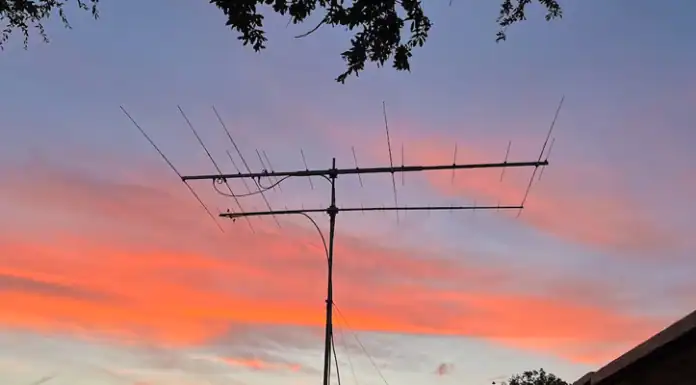
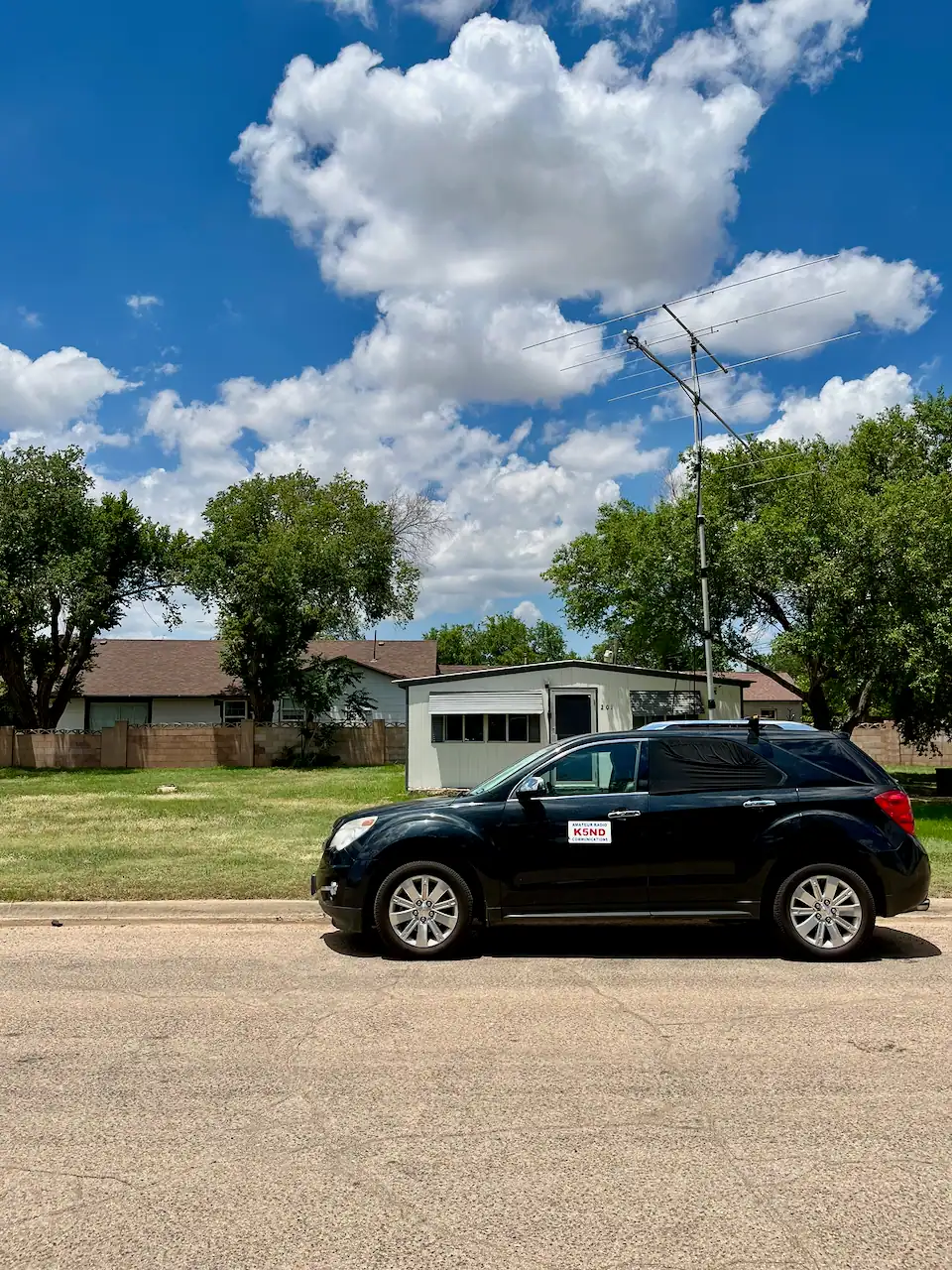 The IC-7100 was controlled by WSJT-X Improved and logged via JT-Alert to N3FJP’s VHF Contest Log. From the IC-7100, the six-meter signal fed a Tokyo Hy-Power HL-166V 160-watt amplifier. The two-meter signal fed a Tokyo Hy-Power HL-200V/50 200-watt amplifier. I used an M2 6MSS 3-element Yagi on 6 meters and an M2 2M-9X 9-element Yagi on 2 meters, both mounted on a MaxGain Systems push-up mast. DC power is supplied by two LiFePo4 100 Ah batteries with a Victron Energy Smart Shunt. I also use a Victron IP22 charger.
DM86 Operation
I used VHF-Chat on Slack for communication. Prior to the activation, I downloaded the list of everyone on the FFMA Leaderboard who needed DM86. I loaded that list into JT-Alert to raise awareness of who to work. I also collected a list from the cacophony on VHF-Chat. I initially managed the list with paper and pencil, but soon switched to Notepad so I could update it easily and post it on VHF-Chat when asked about the list.
On my drive to the Panhandle, I stopped by to see Dan, W5AFY, and trade stories. He shared the nearby Rover Bingo Card created by Wyatt, AC0RA, and Dave,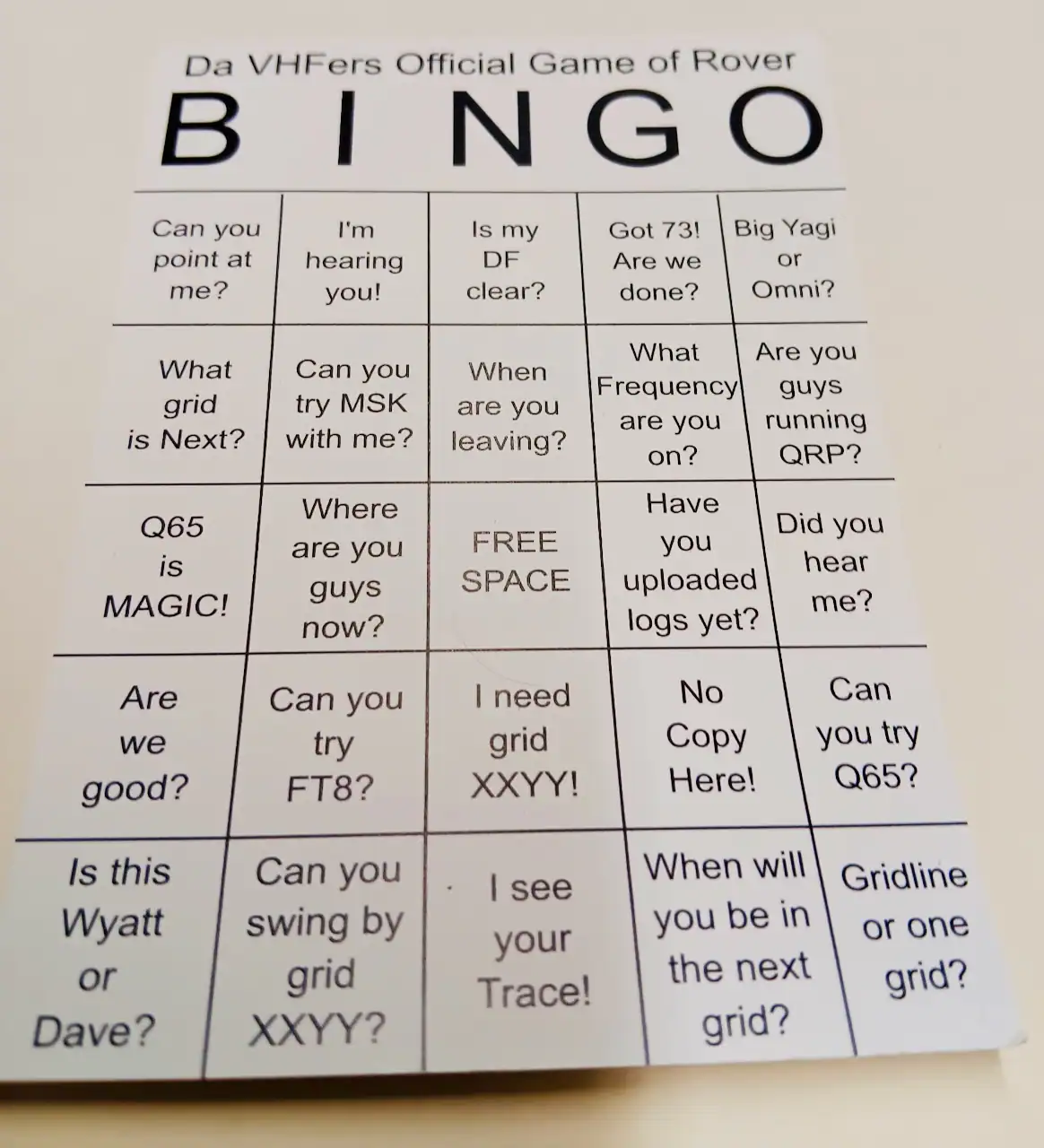 KG5CCI. I didn’t check off every box, but I got pretty close. My favorite was a request from a JA station to try Q65 on six meters, a roughly 6,000-mile path. I declined.
In my initial planning, I hadn’t realized this weekend was ARRL Field Day. That at least got a number of stations on the air, but switching between the Field Day exchange and the regular exchange to suit each station was a challenge.
My equipment issues began with a dead battery in my computer mouse. That should be a simple fix, but when your car is anchored to the ground by masts and antennas, it’s a walk to fix. Fortunately, there was a hardware store within walking distance. Later, back at home and sifting through my stuff, I found a spare battery I’d packed some time ago and forgotten about. Be Prepared is the Scout Motto, but remembering can be tough at 76.
The other challenge was the six-meter amp quitting on Friday afternoon. That night, I took it apart and found an internal fuse that was blown. I had the right fuse, installed it, and it worked through Saturday and Sunday. The challenge on Sunday was 30-mph winds, which put my mast guying and antenna-aiming skills to the test.
DM86 Results
Well, I didn’t get everyone in the log who needs DM86. Conditions were up and down as expected on six meters. But there were good openings to the east, working K1TOL to give him a new county, and to the west, lighting up a number of stations.
Most of my QSOs were on FT8 during the openings. I also made a number of MSK144 and Q65 contacts. Here are the overall numbers.
- 215 QSOs on 6 meters, with 125 Grids.
- 3 QSOs on 2 meters, with 3 Grids.
I had hoped to work far more stations on 2 meters, but my runs there often ended in disappointment. On 6 meters, there were a few unsuccessful Q65 and MSK144 attempts that were later worked on FT8 as the band opened up.
Thanks to everyone who put up with my cranky responses on VHF-Chat, my limited operating skills, and my simple station’s capabilities. You were an unsuspecting participant in my small effort to Pay it Forward by emulating those rovers who’ve provided needed grids over many years.