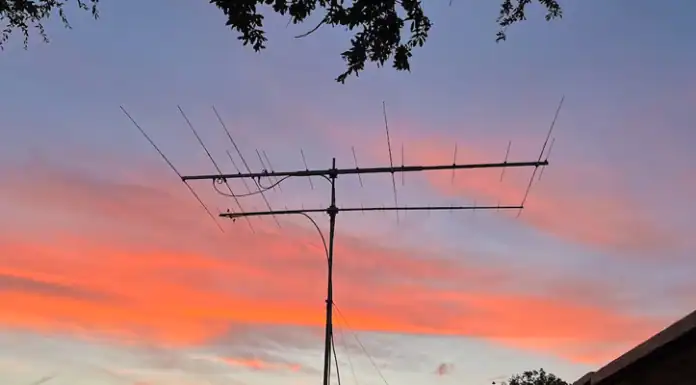

After my last full-blown VHF rover operation in June 2021, I decided to focus on 50 and 144 MHz, selling off my 222 and 432 MHz equipment and antennas. That resolution held for exactly six years! Now I’m adding 432 MHz with more power and better antennas.
So What Changed?
One thing that changed was recognizing my need to get outdoors for VHF contests. That began with my single-operator portable operation for the CQ WW VHF 2024 Hilltopper entry, followed by the ARRL September 2024 contest, and has continued at every VHF contest since.
Between contests, I noodle on improvements to my portable station. I’ve tried all manner of things, but perhaps the best was a 144/432 combo antenna that made it possible to make QSOs with two points on 432, in addition to the one point on 50/144. More QSOs and more points. Can’t sneeze at that.
More Antenna Gain
The challenge of a single-operator portable operation is working stations with only 10 watts. That limits improvements to increased antenna gain and continuous monitoring of each band to catch any fleeting openings. Although it’s not necessarily an opening, it’s catching someone who calls CQ before they give up on the quiet band.
My first step toward this challenge was to bring two radios. One to always monitor 50 MHz, and the other to handle 144 and 432. Then I noticed that people weren’t always hearing me on 432. Solution — more gain. For 144 MHz, I can bring my M2 9-element Yagi. But what to do for 432?
Comparing 432 MHz Antennas
The primary requirement is that the antenna be suitable for portable operation, meaning a reasonable boom length and lightweight construction. My current antennas are the M2 6M-3SS, weighing 6 lbs with a 5’5” boom, and the combo 144/432 antenna, weighing 2.2 lbs with a 5-foot boom.
Striving for more gain on 144 MHz, I’ll bring the M2 2M9X, which weighs 5 lbs and has a 14.5-foot boom. I’ve operated with this setup in the Texas Panhandle, and it performed well.
For 432 MHz, I’d need something similar. The candidates were:
- Directive Systems DSEFO432-15RS at 3.5 lbs and 8 feet with 15.5 dBi, $220.
- Directive Systems DSOFO432-22 at 4.5 lbs and 14 feet with 17.8 dBi, $286.
- M2 432-6WL at 4.6 lbs and 14.5 feet with 18 dBi, $456.
- M2 440-18X at 5 lbs and 11.25 feet 16.5 dBi, $301.
In comparison, my combo 144/432 antennas provide 12.5 dBi at 432 MHz.
For the M2 antennas, for which I had all the measurements, I conducted an EZ-NEC analysis to determine the actual gain when mounted 25 feet above the ground.
Pricing then became a factor, with the Directive Systems 22-element and the M2 18-element emerging as the front-runners.
The final choice came down to the M2 antennas’ ease of assembly and disassembly, making them well-suited for portable operations. For a permanent tower installation, I probably would have chosen the Directive Systems antenna.
DX Engineering Order Fulfillment
I’ve purchased a lot of stuff from DX Engineering. They’ve been great, and shipping is free. This one, however, was much more challenging. They don’t stock this antenna, so when I ordered it in mid-April, the expected delivery date was mid-May. By early May, the delivery date had slipped to mid-June – not in time for the June VHF contest!
I then checked directly with M2, who said they were shipping the antenna to DX Engineering in early May. Meanwhile, DX Engineering sent me a “respond immediately” email asking whether I wanted to cancel the order or wait until mid-June. I said to wait. A few days later, I received a shipping notice, and the antenna arrived in mid-May. An interesting set of messages.
M2 440-18X Assembly and Tuning
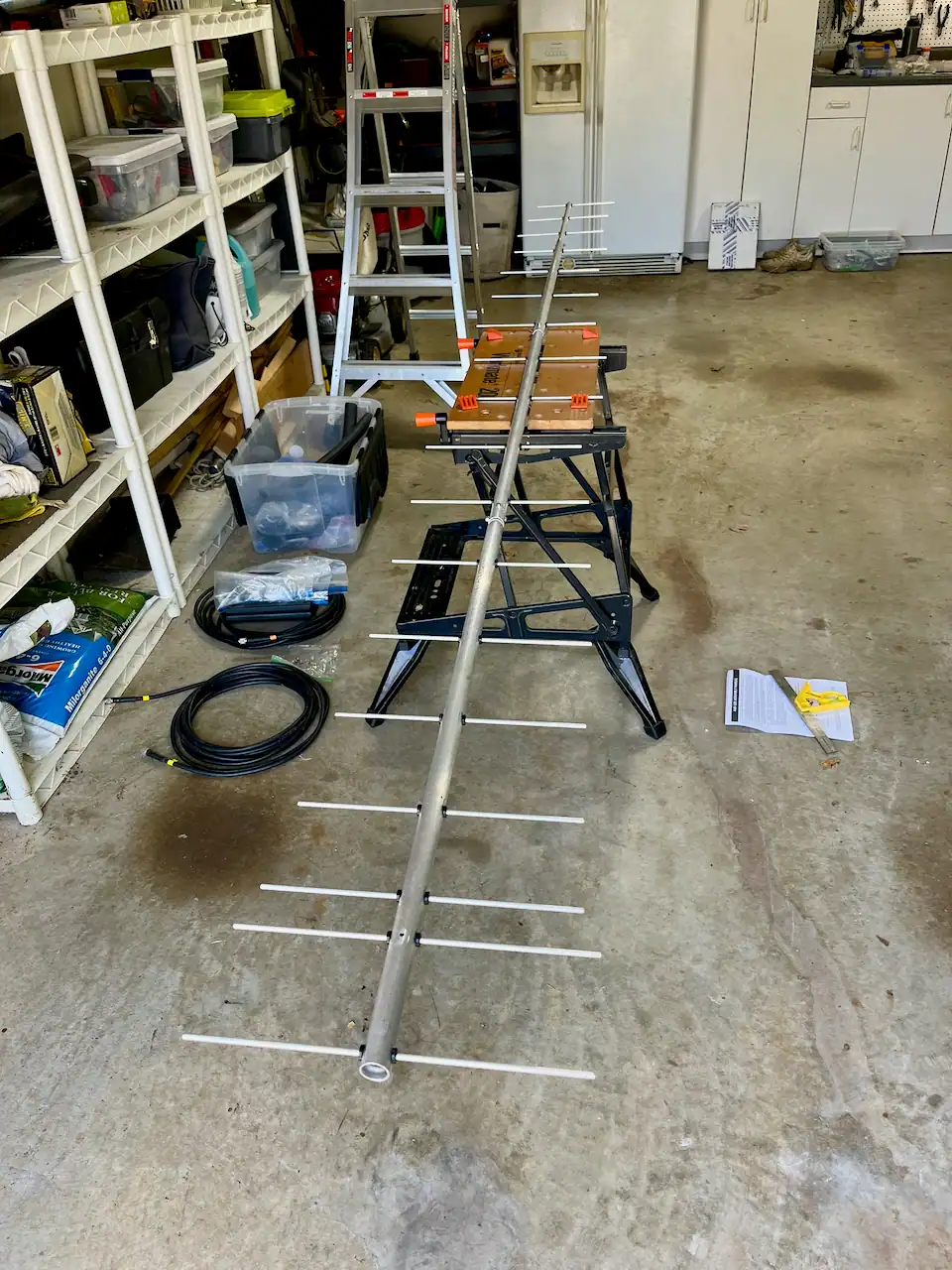 The assembly process is extremely well documented. The challenge is sliding the keepers onto 18 elements. By the time you finish, you’re trained, but it takes patience.
Pay particular attention to the specified length of each director. Lengths vary from shorter to longer and may match the previous director’s length. It is not a simple progression from longer to shorter as you move down the boom.
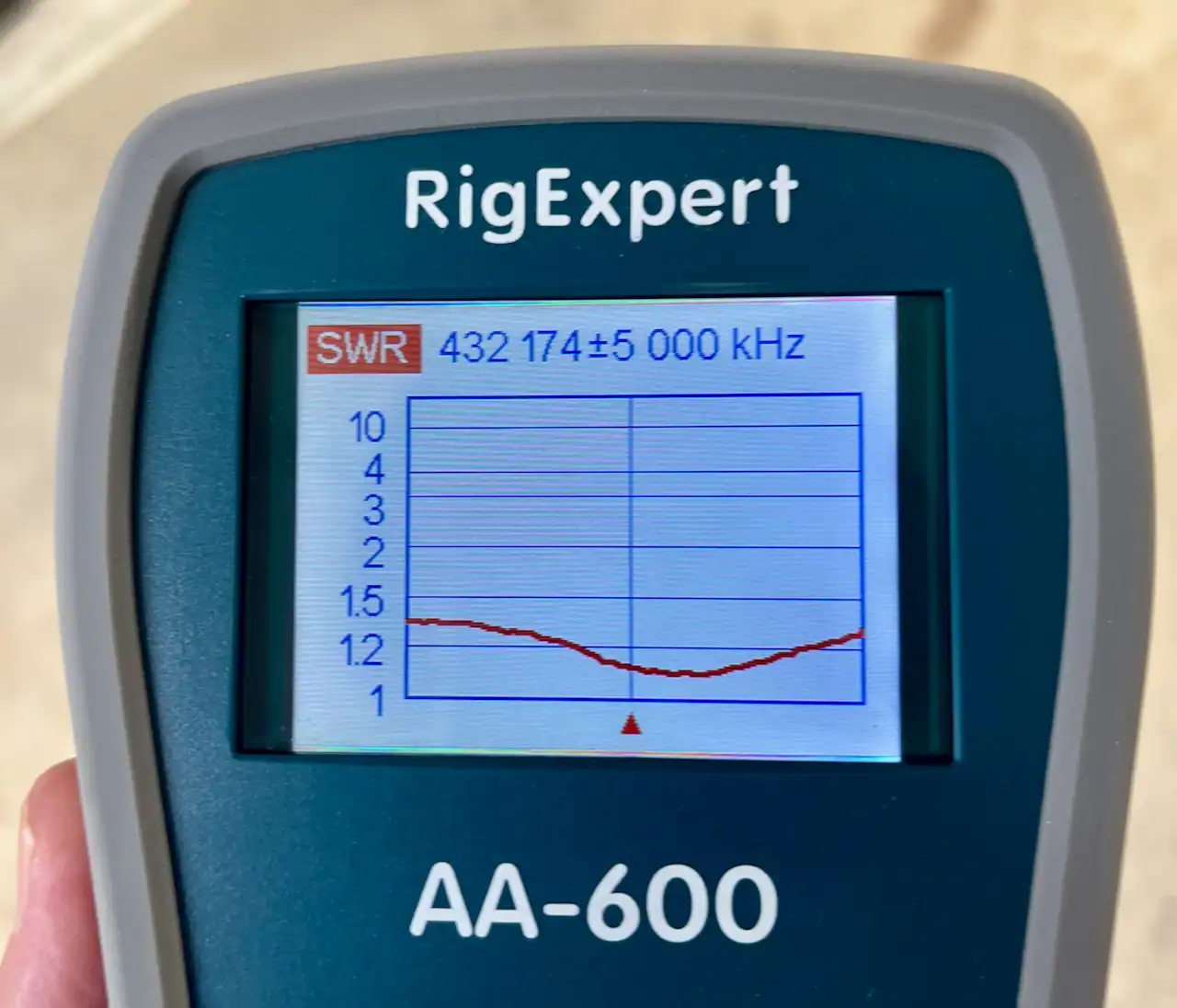
Once assembled, I mounted it on a fiberglass mast section and propped it up on a ladder. I then used a RigExpert AA-600 to sweep the antenna and tweaked the driven element shorting bar. The directions specify a spacing of 3.25 inches, which likely provides the antenna’s full bandwidth. I adjusted it to match the low end of the band, using a spacing of 3.75 inches.
Next up, I will test it with my portable setup as I get ready for the June VHF Contest.
Coaxial Cable
 Generally speaking, I’m not too concerned about coax for a portable setup. I’ve been using 30-foot lengths of LMR-400 coax, which should cause minimal attenuation. However, I also hope to add this antenna to my home station, which will be about a 100-foot run.
If you’ve priced LMR-600 coax lately, you’ll be shocked. Fortunately, I found a ham dismantling his setup and grabbed year-old LMR-600 for a great price. I bought enough to dedicate a section for portable use.
I’m using Messi & Paoloni Hyperflex 13 for 50 and 144 MHz at home. It’s 0.500 inches, compared with LMR-400’s 0.400 inches, but LMR-400 doesn’t appear to be available right now. So, the LMR-600 at 0.600 inches will be a good choice for 432 MHz.
Next Up: Amplifier, LNA, SDR Switch
For my rover operation, I ran 222 MHz with a 120-watt amplifier after the Q5 transverter. For 432 MHz, I ran barefoot into a Directive Systems Rover Yagi. For portable operation, it’s just 10 watts, so no big deal. However, for home use, I’ll want to ramp this up a bit.
So, I’ll start looking for an amplifier option. I see that DX Engineering has a TopTek amp at 150 watts, and I’m watching eBay for other options. My go-to place for LNAs is Downeast Microwave, and the SDR switch to facilitate using an Airspy SDR will probably come from Antennas-Amplifiers.
Always something to improve or at least change in my ham radio adventures.